vsNEO, a Zero-Config KVM Platform Built for Simpler Control Room Deployment
The vsNEO ecosystem delivers professional KVM and AV control with straightforward deployment and built-in security through an air-gapped architecture. No recurring license fees. Just a system built to fit the application.
Built for Small-Scale, Not Small Ambitions
vsNEO isn't tied to one industry. It's built for anyone who needs reliable KVM-over-IP and simple AV distribution – without the space, budget, or complexity of a full video wall processor or KVM matrix.
Dispatch & control desks – reliable KVM switching without a full control-room setup.
Fire & rescue stations – simple and reliable monitoring for smaller installations.
Labs & test benches – control several workstations from a single desk.
Control rooms – reliable operation without unnecessary complexity.
Video walls – easy control of a smaller number of screens.
Also great for sports bars, retail spaces, and lobby displays that need simple multi-source switching.
Engineered for Versatility
Tap or hover the numbered points to explore the connectivity of the vsNEO-link and the plug-and-play vsNEO-center.
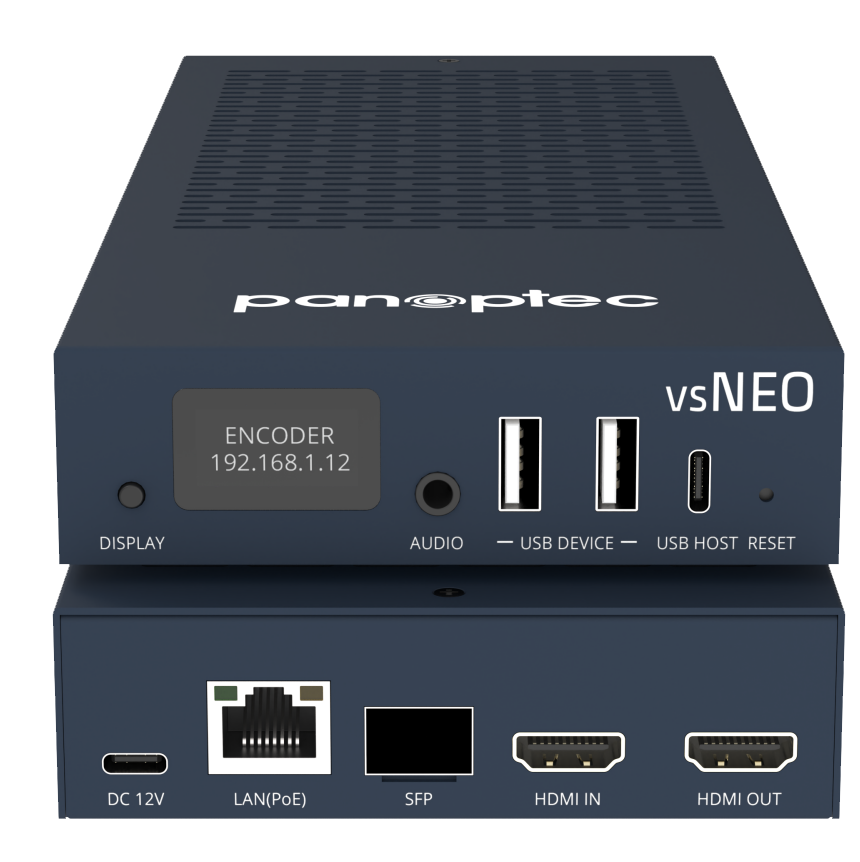
vsNEO-link (Transceiver)
Display Activation
Press this button to instantly activate the OLED display and check the device status.
Small Display, Big Impact
Shows the current IP address and assigned device name. It can also be used as a visual 'flashing' indicator to easily locate the physical unit in a crowded rack.
Analog Audio
Flexible 3.5mm jack. Can be configured as either an audio input or output depending on your workflow requirements.
USB Device / HID
Connect HID keyboards and mice. Features full USB hub support when the unit is used as a decoder at the operator's desk.
USB Host
Dedicated USB-C connection to connect your source computer when the endpoint operates as an encoder.
Factory Reset
Recessed button for safe and quick resetting of the endpoint to its factory settings.
Future-Proof USB-C Power
State-of-the-art USB-C connectivity for flexible 12V local power or centralized MultiPower-12 management.
CatX PoE & SFP Fiber
Choose between the standard 1GbE network link with CATx and PoE, or use the integrated SFP slot for extended distances.
4K@60Hz Capture
Flawlessly captures any connected HDMI source up to 4K@60Hz. Supports uncompressed 4:4:4 processing for the local loop-out, combined with high-efficiency 4:2:0 encoding for the AV-over-IP network stream.
4096x2160 Output
As Decoder: Drives standard TVs or monitors up to 4K@60Hz (4:2:0) with ultra-low latency.
As Encoder: Acts as a pristine, uncompressed zero-latency local loop-out (4K@60Hz 4:4:4) for demanding local workstations.
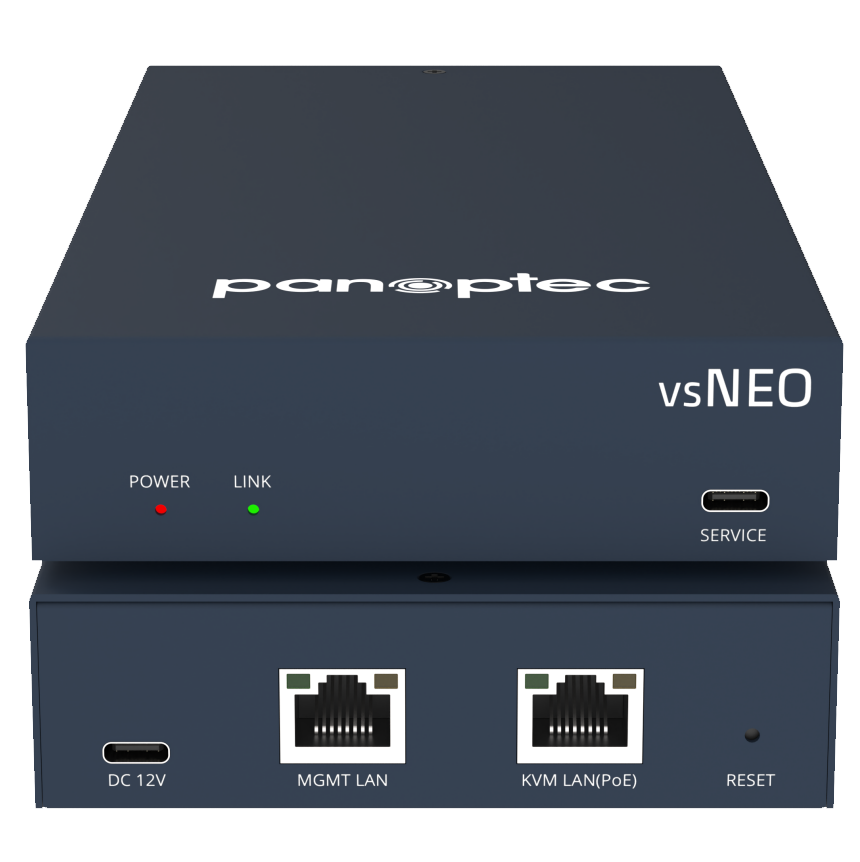
vsNEO-center (Controller)
Power Indicator
Solid red LED confirms the vsNEO-center is receiving stable power and is operational.
Link Indicator
Green LED indicates an active network handshake and communication with the KVM endpoints.
Service Port
Dedicated front-facing port for technical support.
Future-Proof USB-C Power
State-of-the-art USB-C connectivity for flexible 12V local power or centralized MultiPower-12 management.
Management LAN
Physically separated network port for external access. Ensures total isolation from the AV-traffic.
KVM LAN (PoE)
Connects the Center directly to the dedicated Layer-2 vsNEO network switch, controlling all KVM & AV endpoints.
Factory Reset
Recessed button for safe and quick resetting of the controller to its factory defaults.
The vsNEO Ecosystem. Radically Simplified.
A self-contained control room architecture designed around four essential pillars.
1. Isolate
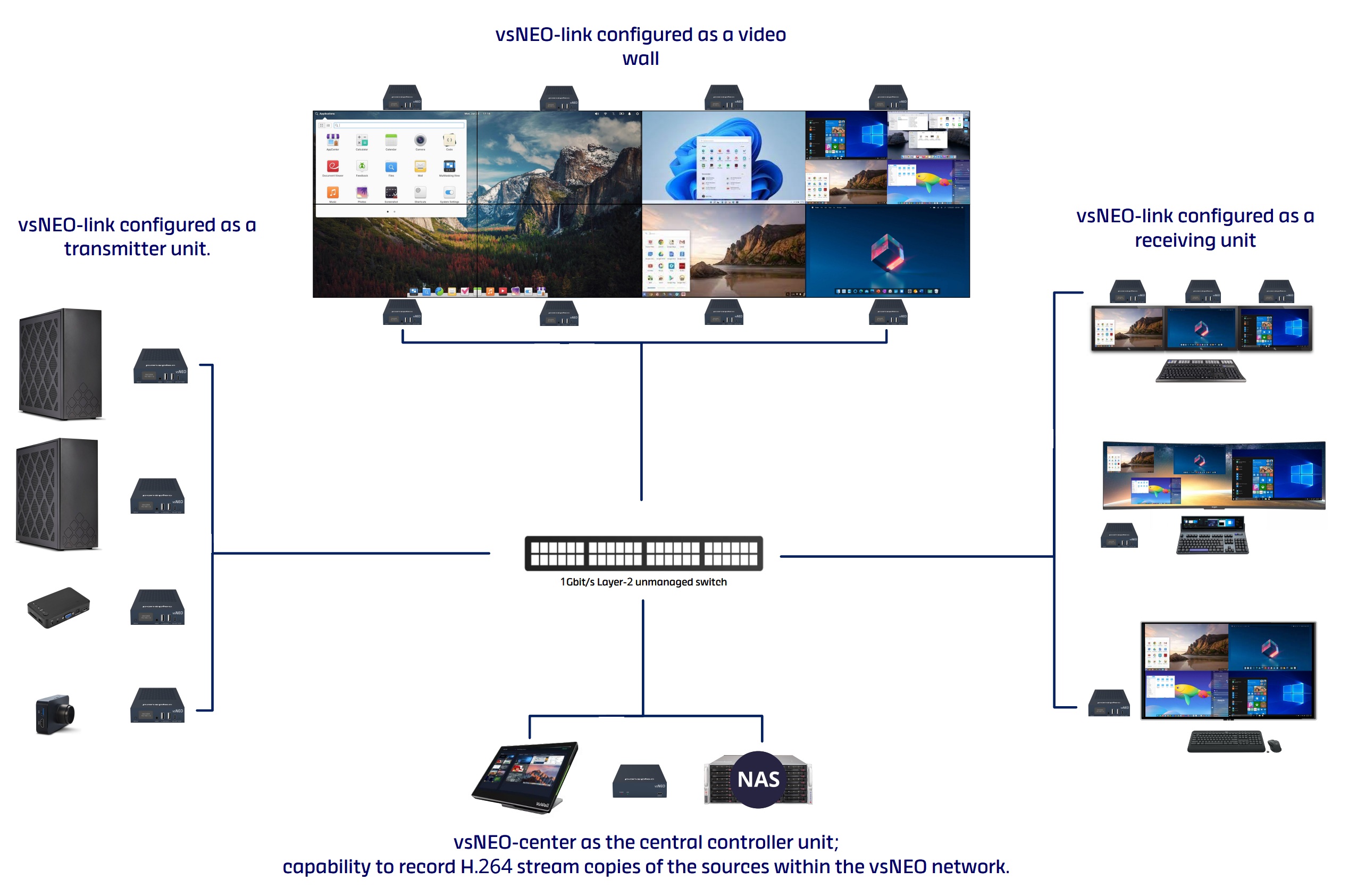
Deploy the vsNEO-center on any standard, unmanaged 1 GbE Layer-2 switch. Its automated DHCP server instantly establishes a 100% air-gapped, AES-256 encrypted KVM network. No complex IT mapping required.
2. Unify
Eliminate hardware clutter. The universal vsNEO-link transceiver acts as a transmitter, multi-PIP desk receiver, or videowall node. It natively captures HDMI/USB while generating an RTSP copy-stream.
3. Deploy
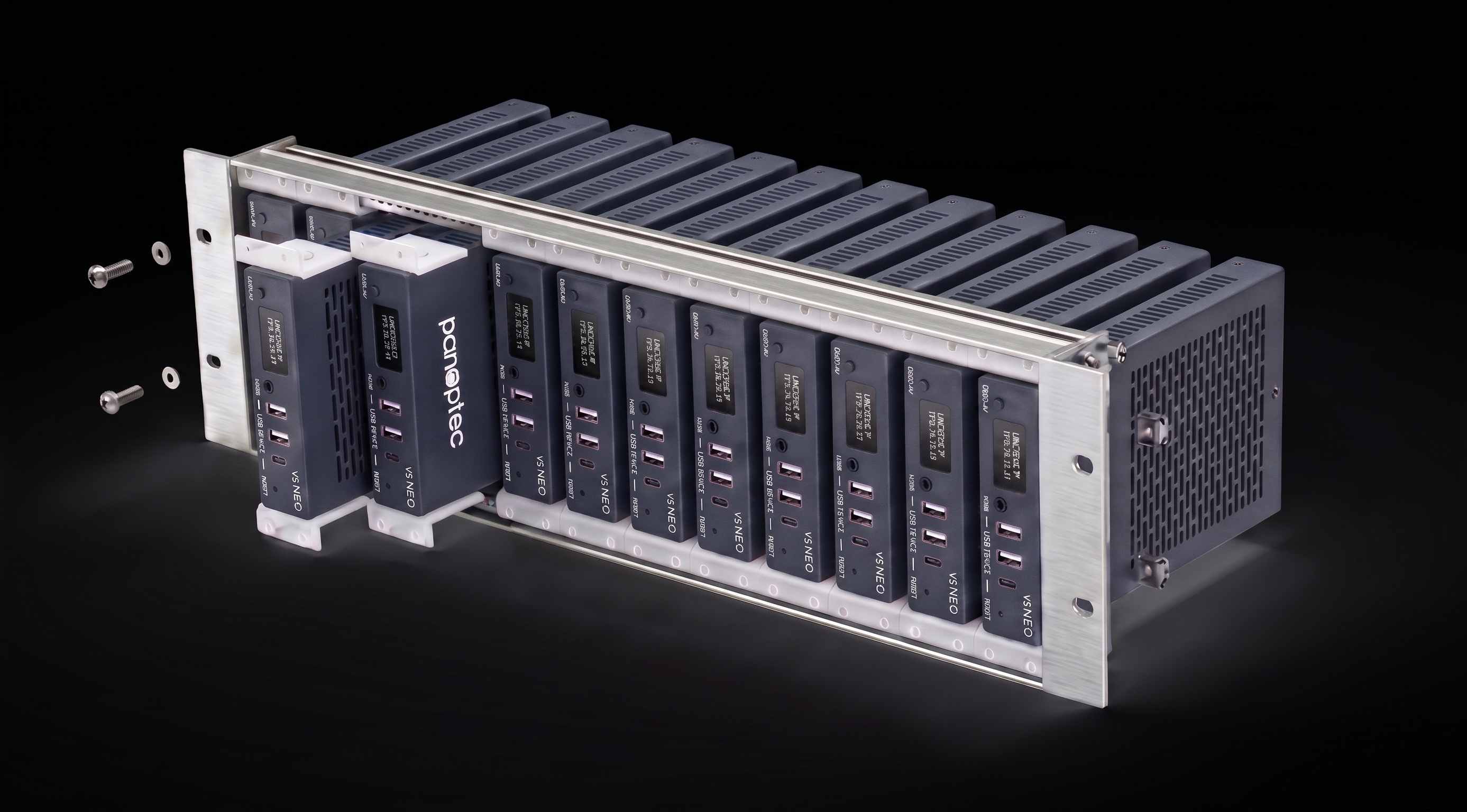
Engineered for the server room. Mount up to 12 vsNEO-links in just 3 Rack Units for maximum density. Active thermal management and redundant failover power ensure rock-solid 24/7 operation.
4. Operate
Take immediate control. Manage sources natively via the frictionless Dark-Mode OSD on your screen, or use the dedicated CommandKeyboard-Advanced touch display for instant drag-and-drop layout execution.
Smart System Capabilities
True KVM-over-IP Control
vsNEO is not just a video matrix. It provides full remote control of your PCs via USB-HID, allowing you to move noisy computers out of the lab or dispatch room.
Seamless Mouse Roaming
Perfect for security desks or local dispatch setups. Control multiple remote sources across different physical screens using a single keyboard and mouse.
Advanced Audio Routing
Embed/de-embed natively via 3.5mm jacks. Mix up to 16 simultaneous audio sources – perfect for operator desks or routing broadcasts in commercial spaces.
Dual-Stream Architecture
While pushing high-quality 4K video, the encoder simultaneously broadcasts a 1080p H.264 RTSP copy-stream to the network for VLC playback, OBS, or recording servers.
Omni-Control Options
Total flexibility for every operator. Switch layouts and sources natively via the OSD, a responsive Web-GUI, or lightning-fast keyboard hotkeys.
Out-of-Band Management
The vsNEO-center features a dedicated, physically separate Management LAN port. Configure your entire system securely from external networks while the AV/KVM traffic stays fully isolated on its own network.
Instant Layout Sharing
Share layouts across displays instantly – perfect for lab technicians or receptionists to change workspace scenes with a single click.
Commercial-Grade Reliability
AES256 encryption, strict user rights management, and HDCP 2.2 support for protected content distribution.
Cost-Efficient Infrastructure
Operates on standard unmanaged Layer-2 PoE switches. No expensive server licenses or complex IGMP setups required.
Intuitive Control Interfaces
Perfectly tailored control for everyday users. No cluttered all-in-one software, but dedicated, fast interfaces right where you need them.
vsNEO-link: Native OSD Dashboard
Designed for fast, everyday workflows. The On-Screen Display runs natively on the decoder – no external PC required.
Real-time live source thumbnails
Intuitive drag-and-drop and layout switching
Context-sensitive control directly on the monitor
vsNEO-center: Central Web-GUI
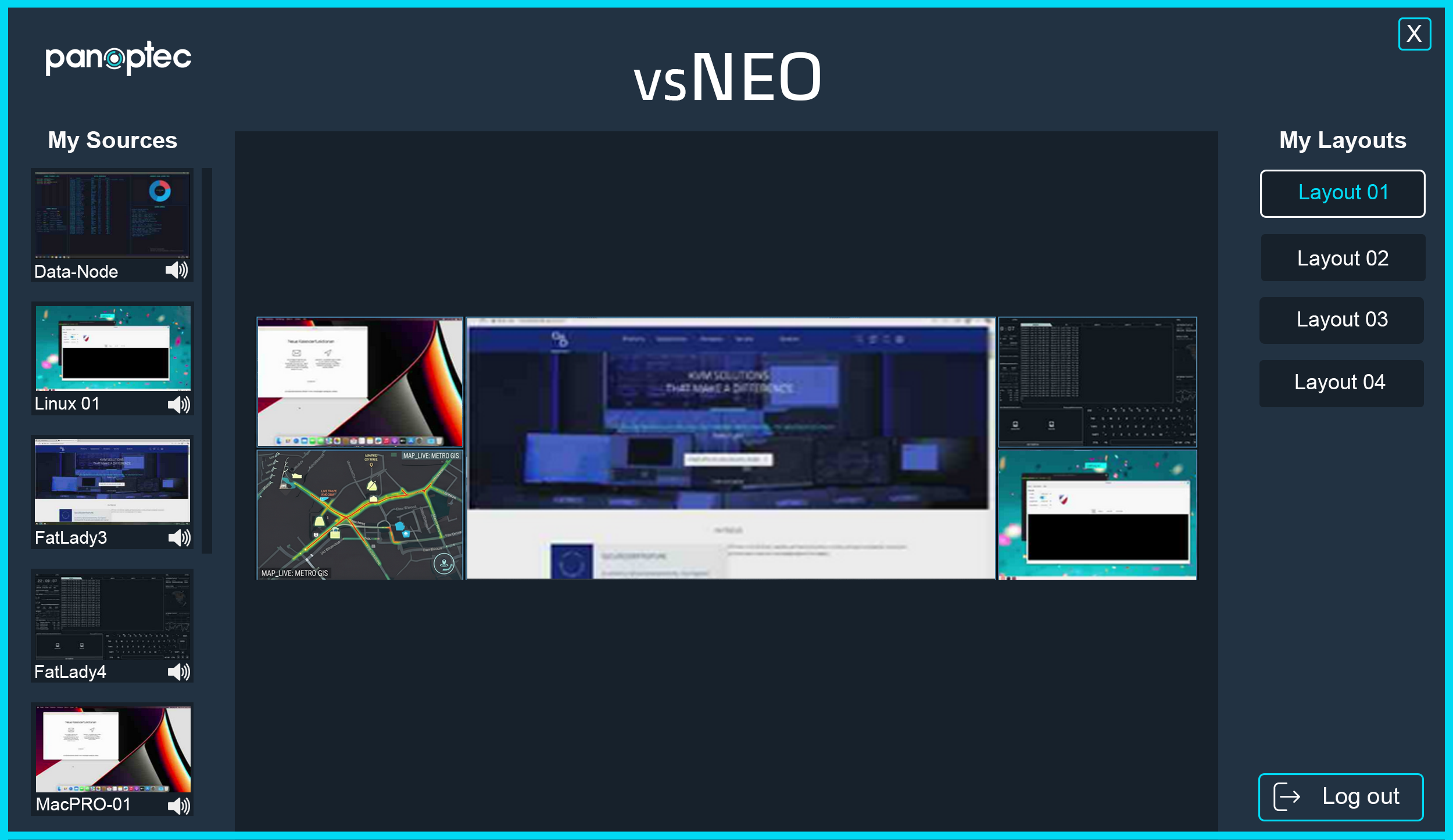
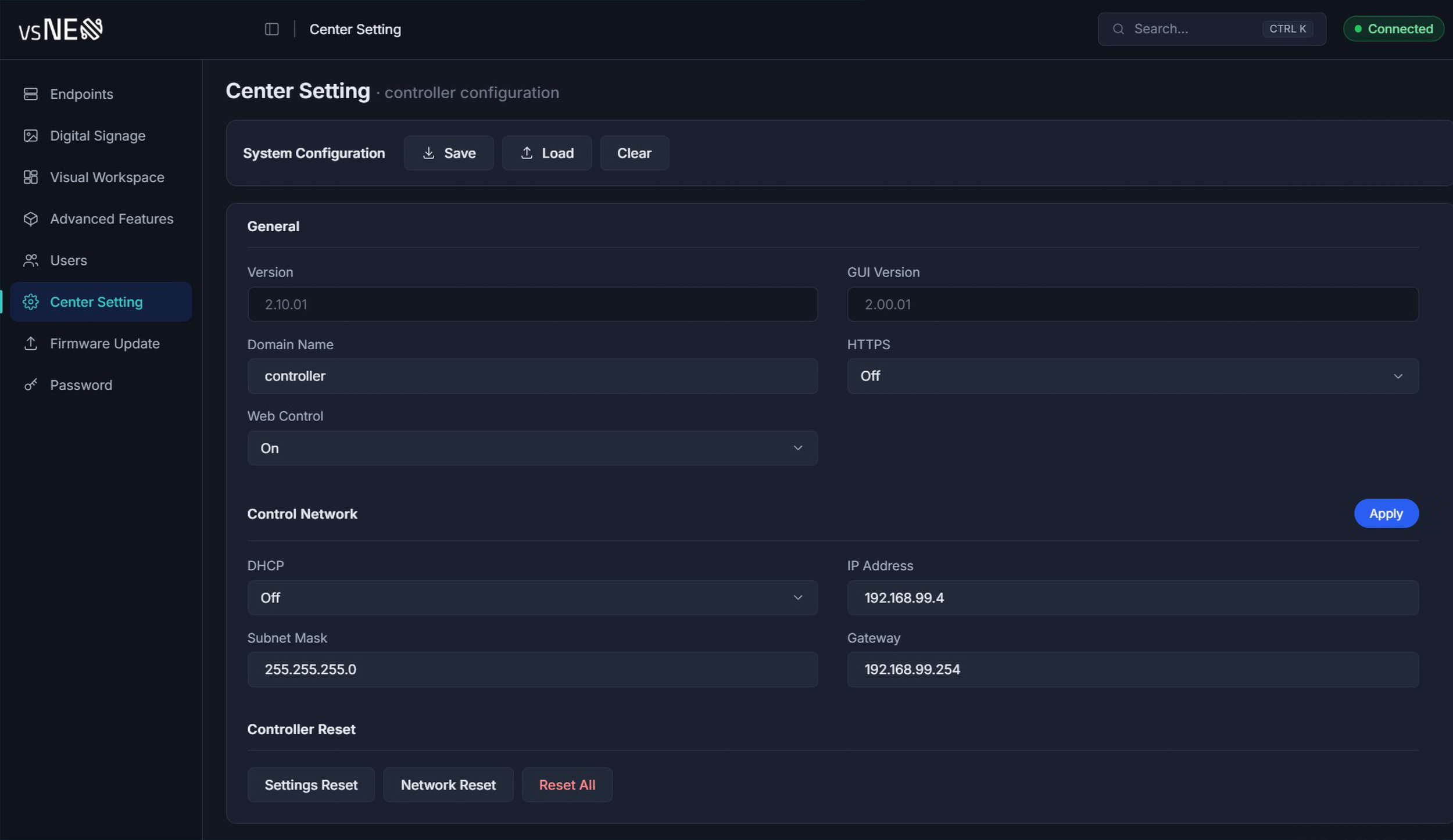
The central nervous system for initial setup. Accessible purely via a browser – configure the system easily without installing any software.
Global system setup and intuitive endpoint routing
Granular user rights management and centralized endpoint configuration
Flexible access: Isolated network or direct in-band configuration
From Simple Switching to Advanced Layouts
Whether you need 1:1 KVM switching or more advanced multiview and video wall layouts, vsNEO gives you the flexibility to match the system to your application.
Simple by Default
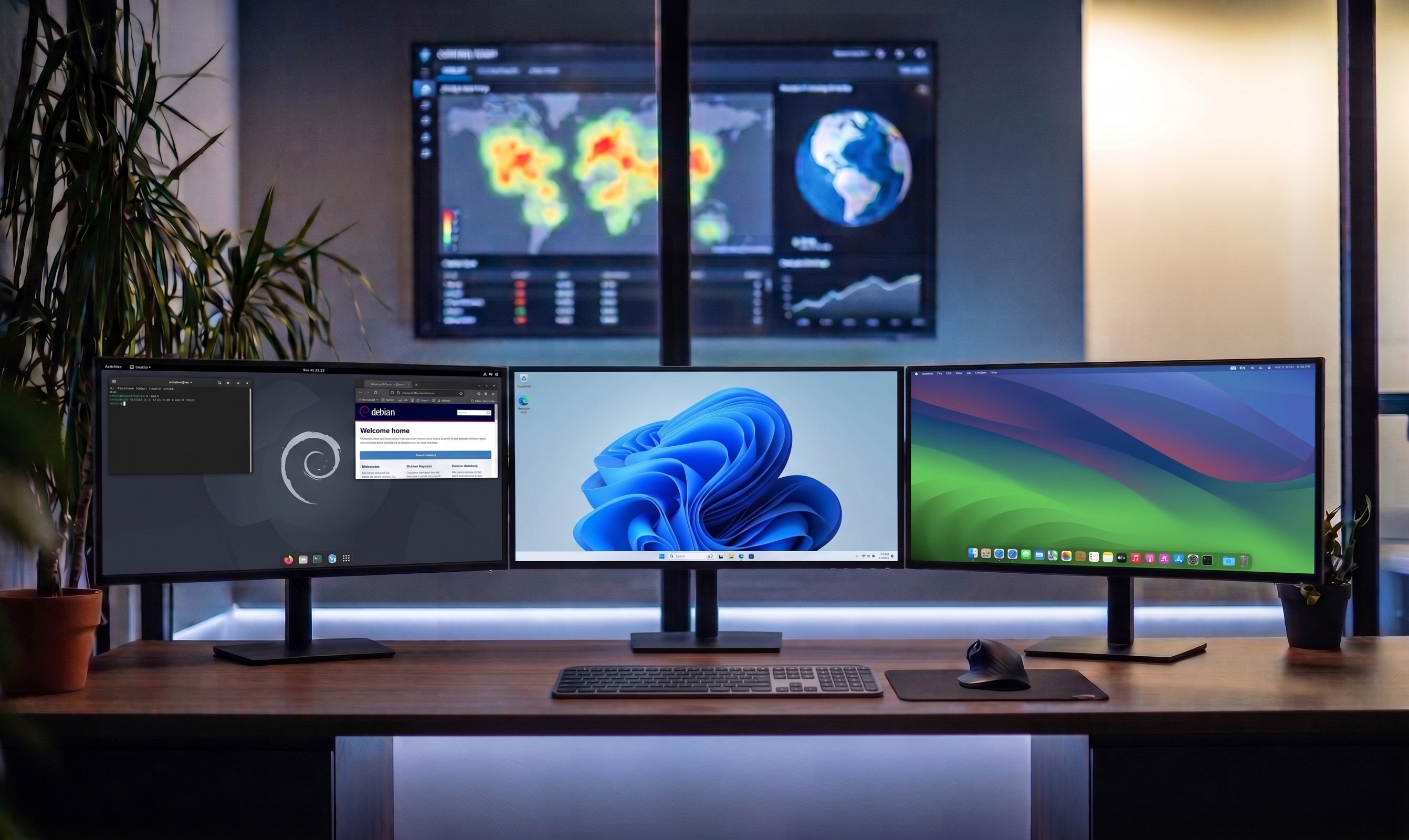
Combine up to 10 monitors into one fluid workspace. Move your mouse seamlessly across physical screen bezels and control multiple sources from a single workstation – without the need for a multiview layout.
Multiview, When You Need It
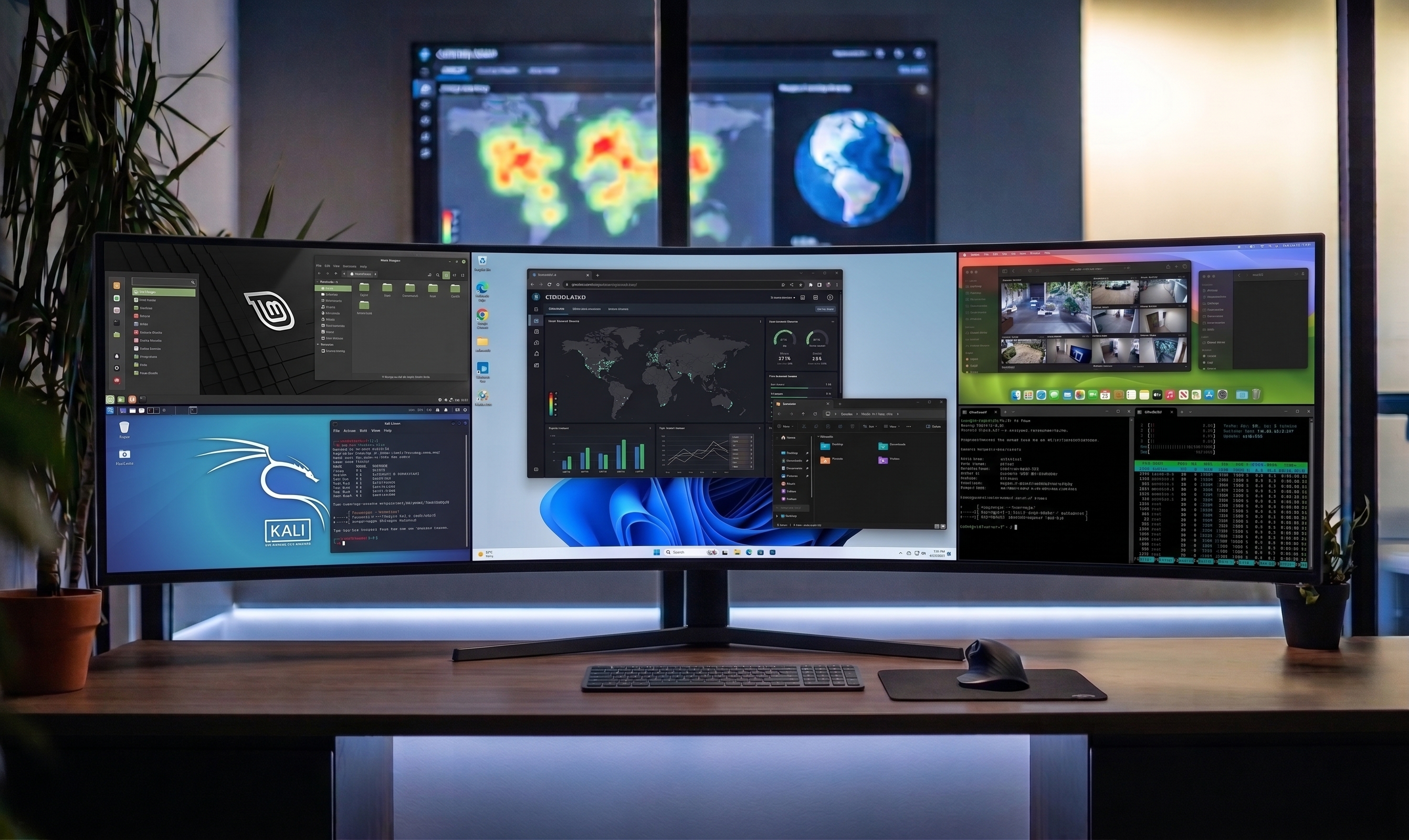
Need to view more than one source at a time? Display and control up to 16 sources simultaneously on a single 4K screen – ideal for high-density monitoring and multi-source applications.
Small Video Walls & PiP
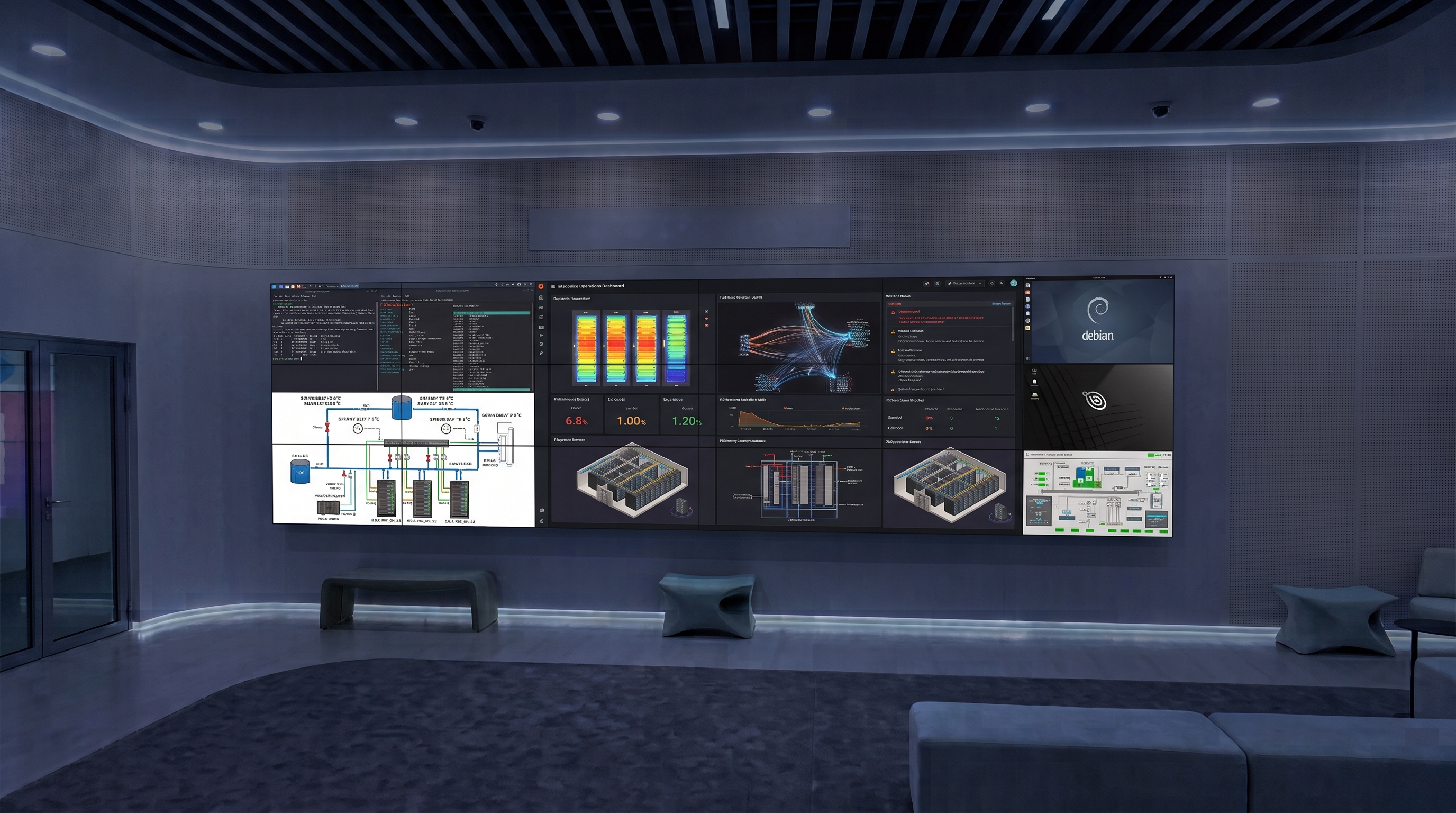
Group multiple decoders to create a synchronized video wall for a lobby, control room, or retail space. Scale sources freely or create picture-in-picture layouts to match the size and needs of your installation.
Scalable Rack Integration & Infrastructure
Whether it's a compact setup or a larger multi-zone rollout, the vsNEO-link endpoints and the vsNEO-center controller fit perfectly into our custom-developed device carriers, complemented by professional power and thermal management.
1RU Device Carrier
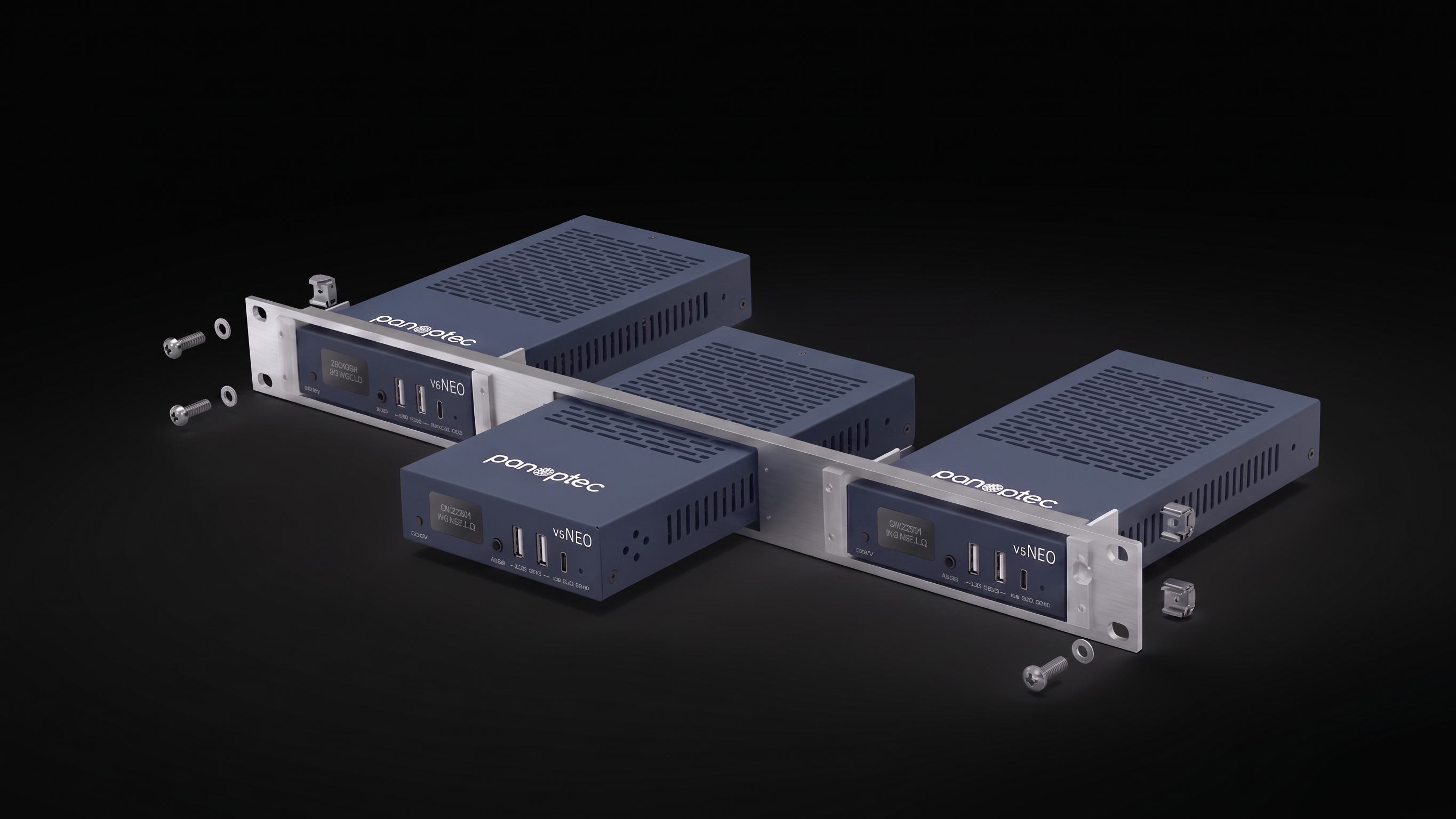
Compact density: Mount up to 3 vsNEO devices (vsNEO-link or vsNEO-center) side by side in a single rack unit within the equipment cabinet.
3RU Device Carrier
Maximum scalability for larger installations: Install and wire up to 12 devices centrally and efficiently across 3 rack units.
Power Redundancy & Thermal Management
100% Power Reliability
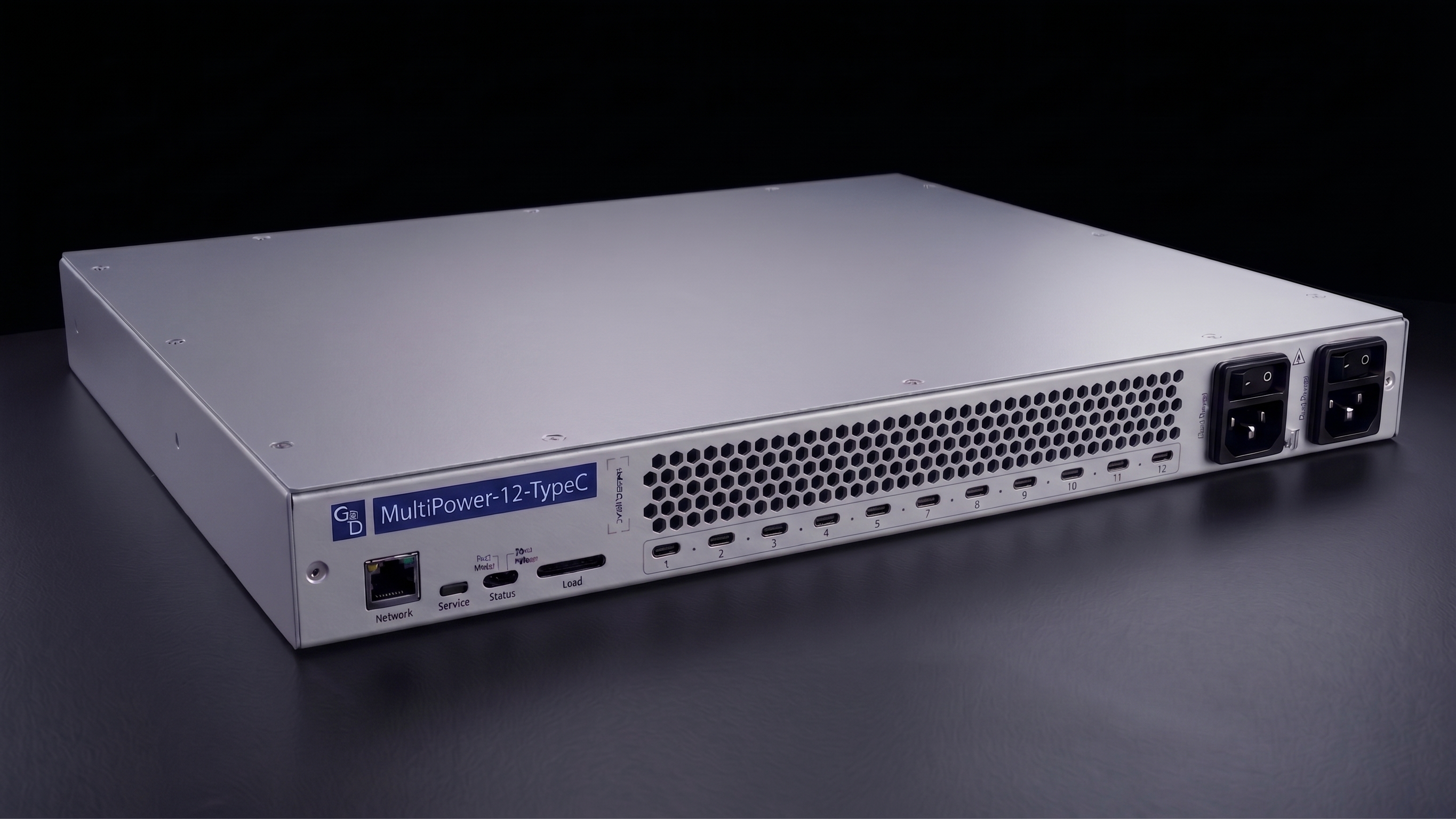
With the G&D MultiPower-12-TypeC, you can centrally power up to 12 vsNEO endpoints via USB-C Power Delivery, with efficient use of rack space and reliable power distribution.
vsNEO-AIR Active Cooling
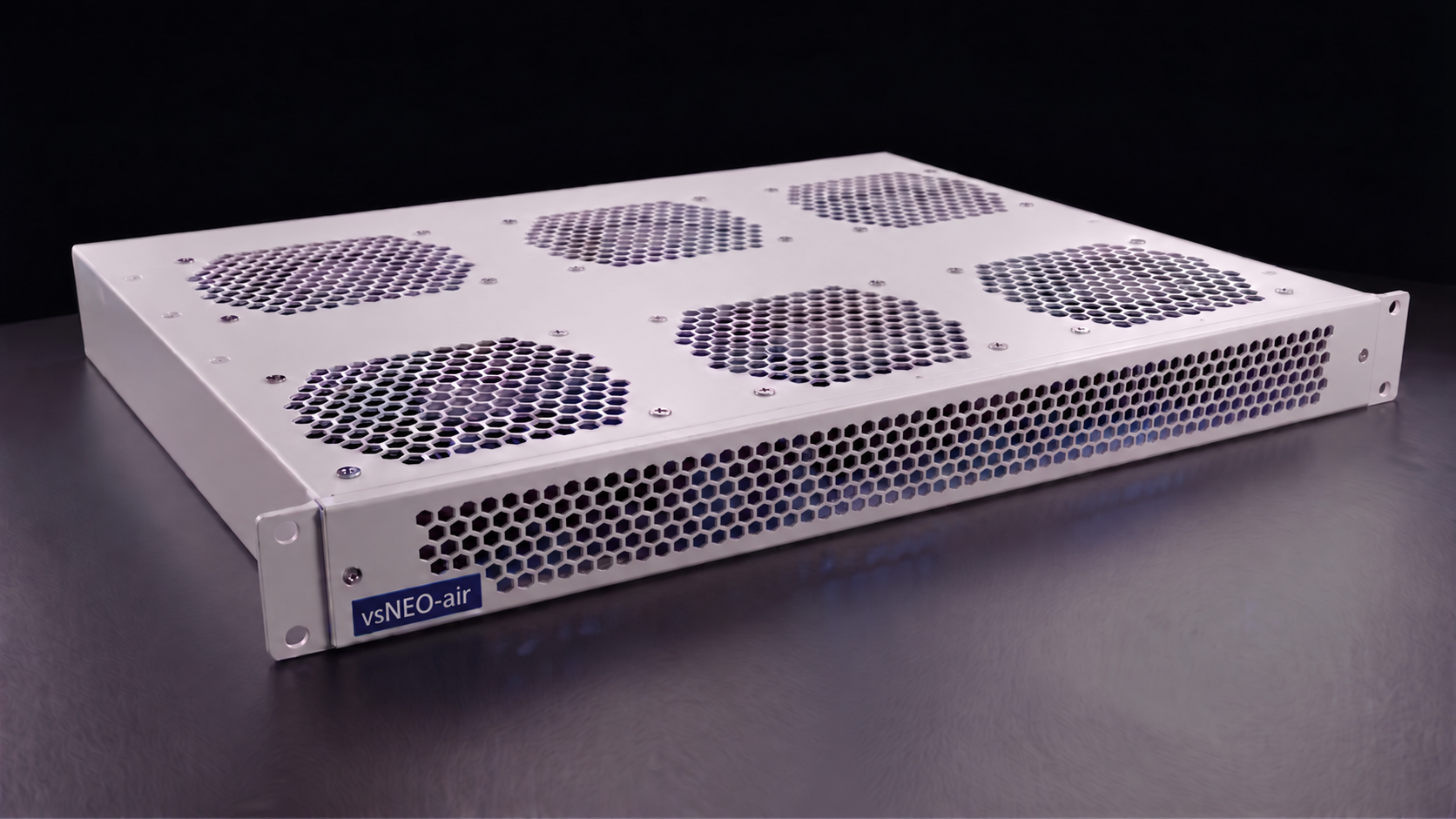
The vsNEO endpoints are silent and passively cooled. In dense, fully populated setups with up to 12 devices in unventilated racks, the vsNEO-AIR module draws cool air in from the front and directs it vertically over the components.
Smart Control Add-ons (Optional)
Every workspace is different. Expand and customize your vsNEO system with optional control devices that make everyday operation simple and intuitive.
G&D CommandKeyboard Advanced
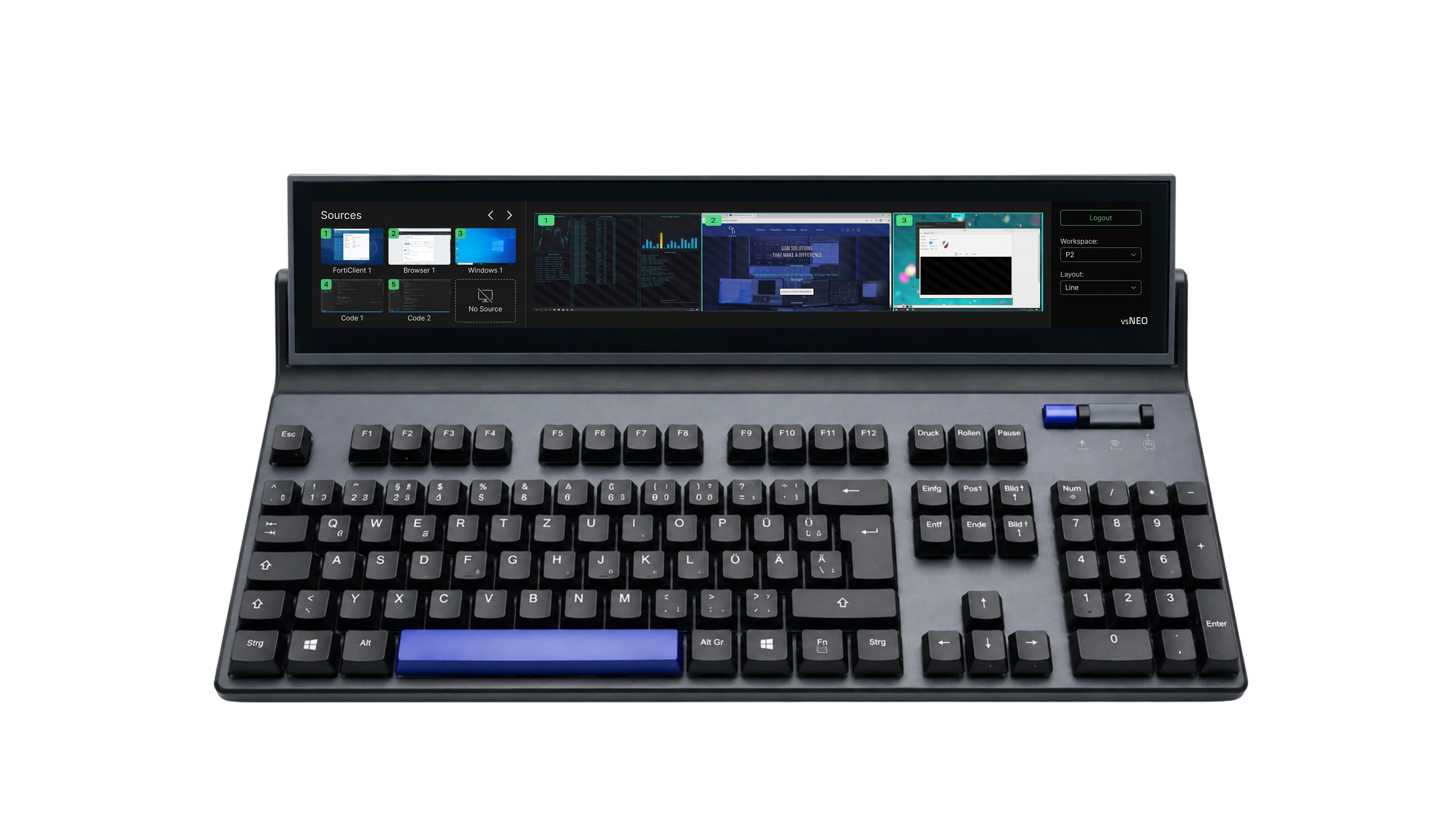
Access the OSD directly from the keyboard. The integrated ultra-wide touchscreen provides clear visual control while keeping your main displays free for content.
VuWall ControlVu
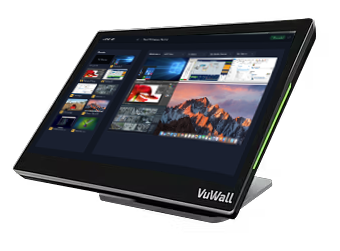
Ideal for reception desks, bar counters, and similar environments. The ControlVu touch tablet provides direct access to the vsNEO-center interface, allowing users to control visual workspaces intuitively by touch.
G&D CommandKeyboard
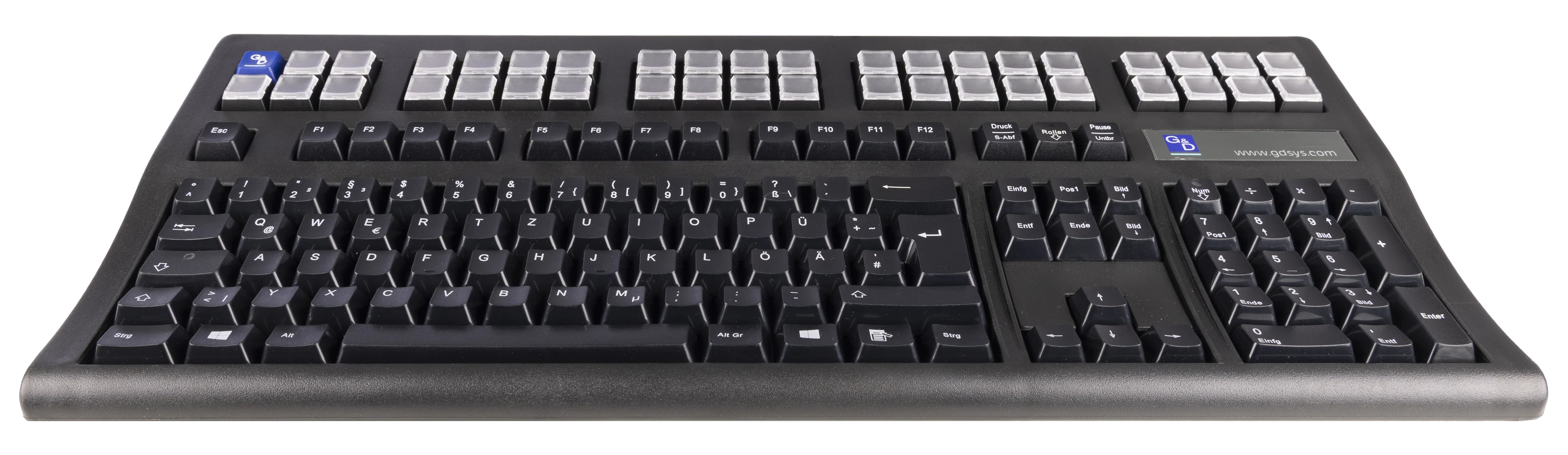
A robust keyboard with dedicated, programmable additional keys for fast layout changes and source switching via HID commands.
G&D CommandDeck
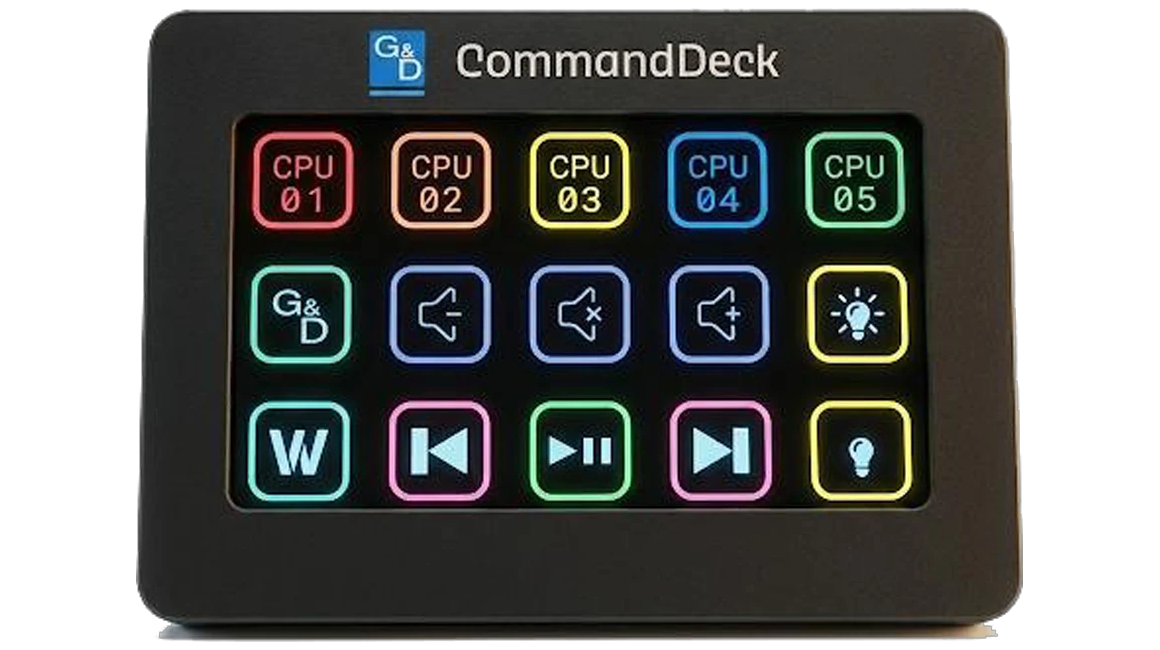
A compact control option for busy environments. Its 15 freely programmable LCD keys allow users to trigger layout changes or switch sources quickly and reliably.
Frequently Asked Questions
Clear answers to the most common technical requirements.
Is the system compatible with standard commercial TVs and displays?
Yes, absolutely. vsNEO endpoints output a standard HDMI signal, making them fully compatible with commercial TVs, projectors, and professional monitors commonly used in labs, retail spaces, and foyers.
Are there any recurring software license fees?
None. All features, including the centralized web-GUI, multi-zone routing capabilities, and On-Screen Display, are fully built-in. There are no per-seat licenses, server software costs, or recurring subscription fees.
Can vsNEO be integrated into our Active Directory (AD/LDAP)?
The vsNEO/KVM network is designed to be fully isolated from your business network – no bridging, no shared switches, no dependency on your corporate IT. To protect this network from IT vulnerabilities, vsNEO uses its own internal, granular rights management rather than relying on external AD servers. For deep corporate IT integrations including AD/LDAP, we recommend our Enterprise solutions from G&D.
Can the system handle multi-head sources?
Yes, absolutely. vsNEO fully supports multi-head Windows systems. You can easily logically group multiple video outputs belonging to a single PC directly within the vsNEO-center Web-GUI. This ensures that mouse roaming and keyboard control treat all screens of the multi-head source as a single, seamless canvas.
Does vsNEO support USB 2.0 for mass storage or touchscreens?
To guarantee absolute data security and prevent malware infiltration (e.g., BadUSB) at the operator desk, vsNEO strictly supports USB-HID only (keyboards and mice). If your project requires transparent USB 2.0 routing or touchscreen support, please refer to our Ultimate Tier matrix systems.
Can multiple users control the exact same source simultaneously?
vsNEO utilizes an exclusive-control model to prevent cursor chaos. While an unlimited number of users can view the same source simultaneously (perfect for distributing a signal to multiple TVs), active mouse/keyboard control is exclusively granted to one operator at a time. However, control handover is completely seamless: the moment the active operator switches away or leaves the source, keyboard and mouse control is automatically transferred to the next connected user viewing it.
Is the system really strictly limited to 96 endpoints?
Yes. This is a deliberate design choice. vsNEO is optimized to run flawlessly on standard 1GbE network switches without requiring complex, multi-tiered multicast routing setups. This guarantees our "Zero-Config" promise.
*Note: When distributing HDCP-encrypted content, standard HDCP 2.2 topology limits apply (maximum 32 devices and 4 repeater levels per branch).
Can I mix different monitor resolutions or rotations (e.g., landscape/portrait) on a single workspace or video wall?
To guarantee perfectly fluid mouse roaming and instantaneous layout switching, vsNEO requires a unified display topology per workspace. Monitors grouped into a single operator desk or video wall must share the same resolution and orientation. By eliminating the need for heavy internal scaling, we ensure maximum system stability and 1:1 pixel mapping. For highly heterogeneous environments with mixed orientations or custom aspect ratios, our Advanced Tier (VuWall) is the ideal solution.
Is there a noticeable delay (latency) in mouse and keyboard operation?
No. The vsNEO platform operates with a highly optimized low-latency video engine and a glass-to-glass latency of under 50 milliseconds. This delivers an absolutely fluid real-time control experience over standard 1GbE infrastructure. However, should your project require physical "zero-latency" – for example, in Air Traffic Control or highly dynamic broadcast mixing – we seamlessly refer you to our uncompressed 10G systems from the Ultimate Tier (G&D).
Does vsNEO feature an open API for Crestron, Extron, or Q-SYS?
No, intentionally not. vsNEO is designed following the Closed-Loop Principle as a highly secure, autonomous system. To rule out external network attacks, IT vulnerabilities, and unauthorized remote control, the vsNEO-center omits open third-party control APIs. Operation and layout switching are instead performed 100% securely and natively via our own hardware ecosystem (OSD, CommandDeck, CommandKeyboard, or ControlVu Touch). For deep AV control-system integration via open APIs (Crestron, Extron, Q-SYS), our Ultimate Tier (G&D) is designed for exactly this.
Is the system built for continuous, commercial use?
Yes. vsNEO is engineered for reliable, continuous operation in commercial environments like local dispatch desks, labs, and retail spaces. It leverages a robust hardware foundation and is engineered for strict CE/FCC compliance, backed by the premium support of the Panoptec Ecosystem. For exact certification details, please refer to our Datasheet.
What are the exact physical and technical specifications?
Below are the detailed technical specifications for the vsNEO ecosystem components. You can expand the data sheets directly here or download them as PDFs for your project documentation.
vsNEO-link (Transceiver)
General
Product group
AVoIP KVM transceiver (encoder/decoder)
Component
Transceiver module (digital) — encoder/decoder
Max. end devices
96 per vsNEO-center
Power supply
USB Type-C (Power Delivery) or PoE (802.3af, Class 3)
Transmission & Network
Range
100 m / 328 ft over copper; extendable via SFP fibre
Medium
CAT5e / CAT6 / CAT6A / CAT7 (copper); fibre (SFP)
Data rate
1000 Mbit/s (1 Gigabit Ethernet)
Network Ports
1× LAN (RJ45, PoE) or 1× SFP (fibre) (only one active at a time)
IP addressing
Fully automatic (Zero-Config) via the vsNEO-center's built-in DHCP server – no manual IP configuration needed or possible
Digital embedded (encoder: embed/de-embed), LPCM 2.0CH, 16 bit, 48 kHz
Audio 2 (Analog)
Combined 3.5 mm jack, CTIA pinout
USB Ports
2× USB device (Type-A, front); 1× USB host (Type-C)
USB classes
USB HID (Keyboard & Mouse supported)
Physical & Operating Conditions
Dimensions (W x H x D)
105 mm x 30 mm x 250 mm
Weight
760 g
Material
Metal enclosure, powder-coated (RAL 5003)
Power consumption
Encoder 10.2-12 W / decoder 7.0-8.5 W
Environment (Operating)
0°C to 40°C / 32°F to 104°F, 20–90 % RH (non-condensing)
Environment (Storage)
-20°C to 60°C / -4°F to 140°F, 10–90 % RH (non-condensing)
Conformities
CE/FCC/RoHS/REACH/WEEE/TAA/CRA
Warranty
2-year limited electronics warranty
vsNEO-center (Controller)
General
Product group
AVoIP system controller / KVM matrix controller
Processor
ARM Cortex-A55, 2 GHz
Max. number of end devices
96 vsNEO-link units
Network
Ports & Data rate
2× 1 Gbit/s LAN (RJ45) — "KVM LAN (PoE)" and "Management LAN", physically isolated from each other (1000 Mbit/s per port)
Transmission distance
100 m over CAT5E/6/6A/7
KVM/AV network addressing
Fully automatic (Zero-Config), fixed internal scheme, not user-changeable
Management LAN addressing
Configurable, supports DHCP client mode for integration into your own network
DHCP role
vsNEO-center is the sole DHCP server on the KVM/AV network; third-party DHCP servers are not permitted there
Control Interfaces & Streaming
Web GUI
HTTPS/SSH-capable, HTML5
Smart & Touch Control
Dedicated URL for a 1920×291 px touch client (CommandKeyboard-Advanced), plus a dedicated responsive web-control interface for tablets, PC laptops, and ControlVU
RTSP copy-stream
H.264, VBR, quality 75, fixed 30 fps
Physical & Operating Conditions
Power supply
External — USB-C (PD) and/or PoE
Input voltage
12 VDC (external adapter)
Power consumption
≈6.84 W
Dimensions (W x H x D)
105 mm x 30 mm x 200 mm
Weight
597 g
Material
Metal enclosure, powder-coated (RAL 5003)
Environment (Operating)
0°C to 40°C / 32°F to 104°F, 20–80 % RH (non-condensing)
Environment (Storage)
-20°C to 60°C / -4°F to 140°F, 10–90 % RH (non-condensing)
Conformities
CE/FCC/RoHS/REACH/WEEE/TAA/CRA
Warranty
2-year limited electronics warranty
Let's talk about your project
Tell us how many sources and displays you need, and we'll help you put the right vsNEO system together.
All three ecosystems carry video, keyboard and mouse over IP. They differ in how much infrastructure they require, how far they reach, and how many source types they can display at once.
vsNEO Ecosystem
Essential Streaming KVM-over-IP
Self-contained, not integrated: A closed system for up to 96 endpoints, with no changes to your IT landscape.
A standard network is enough: Runs on ordinary 1GbE switches, with no multicast configuration.
Isolated security: No domain integration, no mass storage, no extra software at the workstation.
Direct operation: Source selection straight from the on-screen display, with no management software needed.